Andreas Arndt
What started from an AI musician's experience has evolved into a community, a promo platform, and a growing label concept. VMV Records focuses on the humans behind the songs, clear collaboration, and the conviction that AI is merely a tool. What matters is what the artist does with it.
Fake listeners can move money intended for legitimately streamed music. The U.S. Copyright Office is looking to better understand how streaming manipulation works and what measures can help combat it. A recent criminal conviction and data from Deezer highlight different sides of the problem.
Sending a music idea directly to an assistant instead of opening another tool: this is the approach the announced Suno integration in Grok Bot could enable. It is based on a concept where different AI systems handle specific tasks. WILD LAB explains the announcement and its potential implications for creative work.
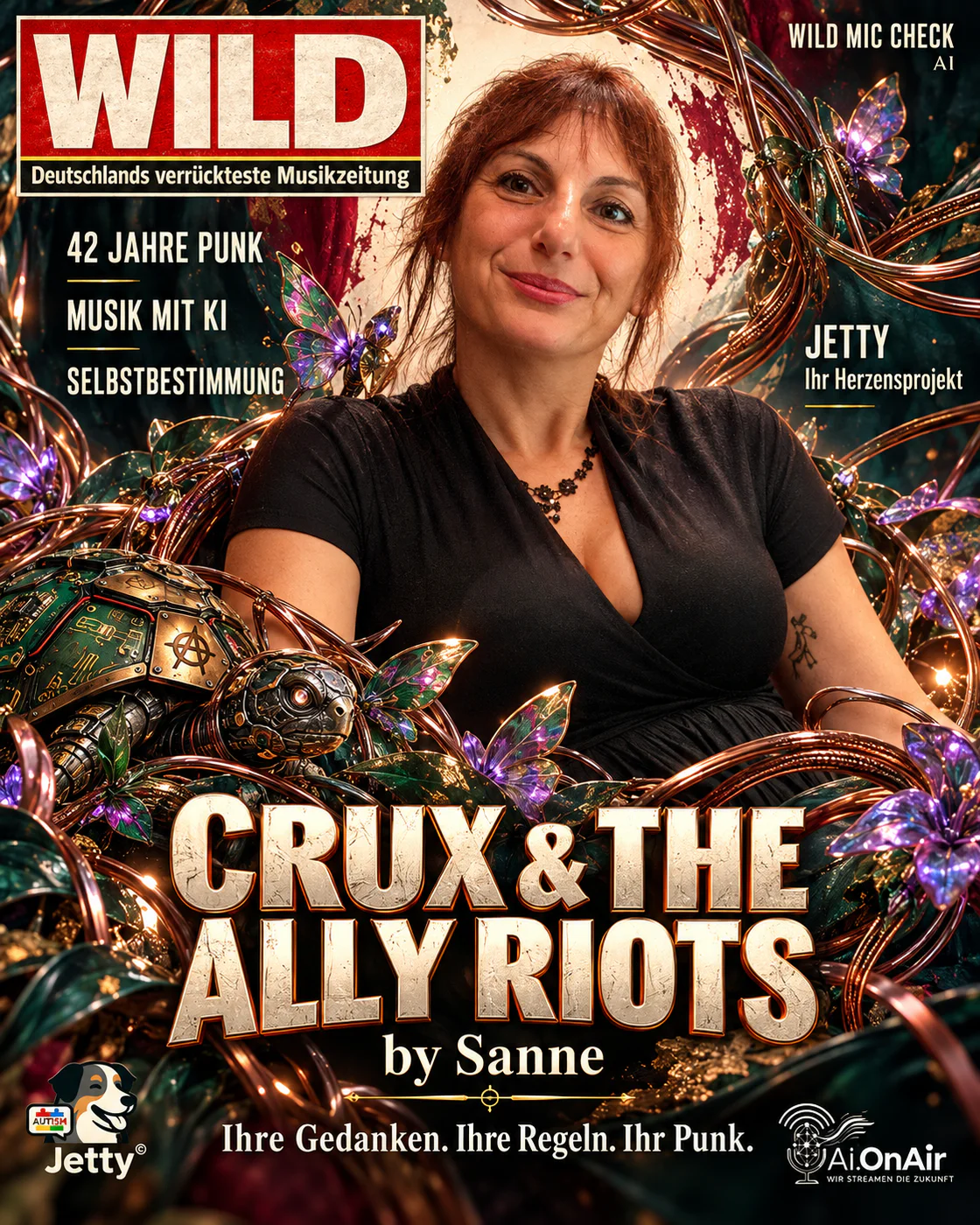
With CRUX & THE ALLY RIOTS by Sanne, a punk artist from Pirmasens brings her poems and experiences to life. She talks about her autism diagnosis, love, loss, and sarcasm, explains her work with AI, and is looking for people to bring her music to the stage and help realize her passion project, JETTY.
An established AI workflow can change without the user doing anything. Google is reordering model access in its Gemini apps and tightening the boundaries between its subscription plans. WILD LAB explains the announced changes and what musicians and creators should consider when choosing a plan.
Suno promises that paying users can use their downloaded songs commercially. At the same time, their terms of service grant the company far-reaching rights, extensive control over accounts, and complicated rules for legal disputes. Italy's competition authority is now investigating whether this creates an unfair imbalance at the expense of consumers.
Between saved drafts and a finished music project lies the decision of which tracks belong together. Suno's 'Albums' feature provides a framework for exactly that. A selection spanning country, electronic music, and other styles shows how differently users can fill this space.
A song written in grief for her mother led Conny to start songwriting herself. Today, the artist name pegesus15 represents a personal musical world developed entirely on her phone. In the WILD MIC CHECK, she talks about sleepless nights, her love for direct lyrics, and the wish to leave something of herself behind for her children.
One instrument, multiple identities: Within just a few days, an unusually productive firmware scene has emerged around the M-VAVE FM-1. Free open-source projects and a commercial system are replacing the manufacturer's interface and fundamentally changing the sound architecture, sequencer, and workflow. WILD LAB clarifies what these alternatives actually achieve, why the low price accelerates development, and where real risks arise when flashing.
Sony Music reported more than 260,000 suspected AI imitations to streaming platforms for removal by the end of September 2026. However, this spectacular figure doesn't represent a tally of legally confirmed violations, but rather a growing mountain of takedown requests. The critical conflict is therefore not 'Human vs. AI,' but rather: Who is responsible for preventing foreign voices, names, and reach from being used as raw material for deceptive releases in the first place?
Kelly Clarkson wants to give AI music its own place in the charts. On the podcast 'Las Culturistas,' she compares competing against robots to machines participating in the Olympics. But between fully generated songs and human music with AI support lies a gray area that any new chart rule would first need to define.
A waitress in New York warns about shellfish allergies, yet the guest insists on ordering based on ChatGPT. A River Ranger in the Mountain West shows visitors a map to explain why their AI-generated travel plan is physically impossible, only to be met with skepticism. A childcare provider in New York is told that two to three hours less sleep per night is sufficient, while parents point to a ChatGPT sleep schedule. A report by The Verge from October 2, 2026, collects these experiences and identifies Meta's new AI agent, Muse, as a potential factor for further escalation.
An AI song, a cloned voice, or an artificially generated concert recording: on YouTube, what matters is what can be heard and seen in the final upload. Disclosure requirements have been in place since 2024. Musicians should take a close look at the current rules, as there are significant differences between production assistance, synthetic music, and realistically simulated people.
Suno CEO Mikey Shulman described the continued growth of his platform at the Bloomberg Screentime conference in Los Angeles. According to him, the platform now has well over two million paying subscribers and 300 million dollars in annual revenue. Meanwhile, the legal battle with the music industry is escalating: Universal Music Group and Sony Music sued Suno on September 18, 2026, for alleged copyright infringement.
On October 1, 2026, Suno released Speech (Beta), an AI model that generates spoken language and accompanying music simultaneously in a single track. According to Suno, it is the first audio model to combine both in one pass. The beta is open on mobile and web, although Suno explicitly acknowledges its current limitations.
Suno CEO Mikey Shulman confirmed at the Bloomberg Screentime conference that the AI music platform is far above the previously announced 2 million paying subscribers and 300 million dollars in annual revenue. He did not provide any specific new figures. Meanwhile, legal battles with Universal Music Group and Sony Music continue to rage. The CEO used the stage to explicitly welcome the lack of firm rules for AI music.
WILD is an innovative digital music magazine that focuses intensely on the AI music scene, featuring exciting interviews and exclusive columns, all delivered in peak digital form.
Ollis Plattenküche started as a marketing livestream and evolved into a vibrant community stage where AI-generated music is heard, discussed, and shared.
For Olli, authenticity is the core of his format. He avoids a curated image and wants to be exactly the same person in his livestream as he is in his everyday life.